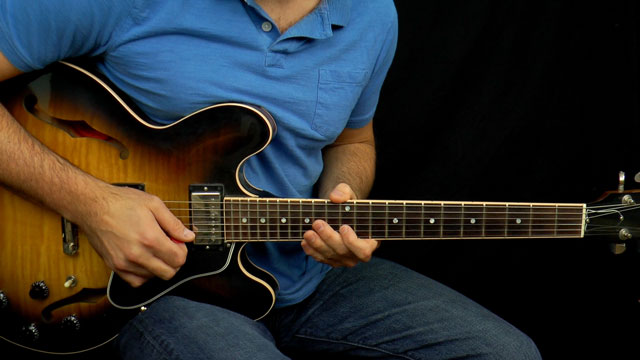
In this lesson, you’ll learn how to play a ZZ Top inspired rock blues rhythm and solo in the key of G. This solo utilizes all five of the minor pentatonic positions. I tried to make this track similar to something you might hear off of their first album.
ZZ Top Style Blues Lesson Podcast 69
Category: Video Podcast
October 9, 2019 / Level: Beginner / Style: Rock Blues / Key of G
Full Lesson, Interactive Tab, Guitar Pro, and Backing Track
Gain Instant access when you become an All Access Pass Subscriber. Learn more about All Access
Read Full Transcript
Hey guys, John here at LearningGuitarNow.com, and in this lesson, I want to show you how to play a ZZ Top style 12 bar blues playing the key of G. This solo covers all five minor pentatonic positions, so I think it's a great exercise to learn a solo something like this to where you're moving across the entire fretboard. To get the tone for this lesson, for the lead guitar, I used a 57 tweed twin reissue, pretty much cranked all the way up. For the rhythm guitar part, I used my 1966 Fender Vibrolux, and it was pretty much cranked up as well.
For both parts, I used the bridge pickup on this Les Paul. We'll go ahead and take a look at the first few licks for free, and if you would like access to the full lesson, including the rhythm guitar lesson, as well as the interactive tab and backing track, check out the All Access Pass. Okay, let's go ahead and start the lesson. Okay, now I'm going to break this solo down for you into nine separate licks.
This is a 12 bar blues, and we're in the key of G. Lick one sounds like this. Okay, so that is lick number one. This is kind of a classic blues riff that you hear off of Freddie King going down to, and it's just a must-know riff for any blues guitar player to know, and we're simply just walking down the pentatonic scale from the second position to the first position.
It's also just a great beginning exercise to getting used to playing some kind of blues sounding riffs. So I'm doing a rake. You don't have to do one. You could do one.
You know, you can just kind of improvise that kind of thing, but I'm raking from the sixth to the eighth fret on the B string, taking me from the first position pentatonic to the second position. So you got we're going to let that hold out for four beats. Got one, two, three, four. Then I'm going to do it again.
Just kind of hammer the second time. I don't really slide though. Just a fast hammer. I'm adding a rake too.
Once again, you can put rates in the different positions. It's up to you. Hammer on six to eight on the B string. And then now our C chord is actually going to happen now because this is a quick change 12-bar blues.
That means the one chord G is going to happen for the first bar, and then we're going straight to C. This quick change. You got that. Sixth fret on the B.
Now slide backwards to the fifth fret on the G string. Third fret of the G. And then fifth fret, our root note right here on the D string, fifth fret here. Add some vibrato to that note.
And then we're going to hit this little phrase. Three, five, three on the G string. And that's an eighth note triplet. We have the beat going like this.
One, two, three, four. And so triplets are just one, two, three, one, two, three. That little lick, eighth note triplet. This Chuck Berry style move.
So we have the last note. So three, five, three on the G. And now we're going to bend up fifth fret slightly on the G string. Bar your first finger on the high E and the B.
Third fret here. Now slide backwards again to the fifth fret of the G string. Third fret on the G string. And you can kind of bend that third fret just slightly.
End on the fifth fret of the D string, our root note here. So just kind of a classic blues sounding riff. Two, three, four. You can also bend that third fret slightly as well.
And we're doing all these notes right here, right on the beat. One, two, three, four, one, two. And so that counting that would be one, two, three. That's how you can count some of those pieces to get the sound right in rhythm.
Pretty basic little riff there. Sounds great. You're here Clapton using that. I said Freddie King using that.
You can use it over any style of blues. So it's just a must-know riff. So if you're improvising and don't really know what to do at the beginning of a solo, play that riff. It's really catching to your ear and it'll grab the audience's attention, I believe.
A cool riff like that. And if you're improvising, a lot of times maybe another guitar player might come in and harmonize with you or maybe a keyboard player. So it's an excellent riff to know. Okay, so that is lick number one.
Okay, lick two sounds like this. Okay, lick number two is very similar to lick number one. We're repeating that phrase just to grab the audience or listener, whatever you want to call it, to the solo. I like to do that kind of stuff.
I repeat phrases here just to see the solo more continuity. So I'm sliding into the seventh fret of the G string right before we get to the next bar. Then I'm just doing that phrase over again. Two, three, four.
Now I'm going to do this riff a little quicker and change up some of the notes. So I had one. So the count on that is pretty simple. We're doing a lot of eighth note triplets here.
So I have one now triplets on this. That's your second beat. Third beat. Fourth beat.
You can also accent the first note of those eighth note triplets just to make it stand out. Accenting means I'm just hitting it slightly harder. If you don't want to accent, sometimes it might kind of sound a little flat. You don't also always have to accent, but it does make certain notes stand out in eighth note triplets.
Cool little move-de-do. That's when I'm accenting the first note of each eighth note triplet. Accent. Accent.
Accent. Accent. Using accents like that just helps things to pop out a little bit more. But just a great little exercise too if you want to get used to playing those type of eighth note triplets.
So for the lick, I'm doing this. Just doing the Chuck Berry move. Then I'm bending sixth fret on the B string slightly. And then barring my first finger on the third fret the whole time.
Now bend sixth. Bar your first finger. High E.B. That's just a must-know blues riff.
You hear every single blues guitar player doing that kind of stuff. So if you can't do that really good, make an exercise out of it. Playing at all different keys. Key of C.
So it's just a great thing you have to know. After we do this for the lick, I'm sliding six to eight. Really simple. Slide six to eight on the B.
Hit it twice and then heavy vibrato. A lot of times you'll hear Billy Gibbons do this kind of stuff. It's just really easy to play. But you just got to get the feel right doing the accents like that.
And also getting a very smooth vibrato that's relaxed and also fits the tempo of the speed of the track you're playing over. Okay, so that's it for lick two. Okay, lick three sounds like this. Okay, so that is lick number three.
You hear Billy Gibbons doing this kind of stuff all the time. And this is played over the five chord, the D chord. And right before the bar happens, the D chord is being played over. I'm just hitting six, seven.
And then now we're going to do this phrase over the five chord. Bending that sixth fret slightly on the B string. Realize that seventh fret on your G string is your D note. And so it sounds great.
If we're thinking about this in terms of D, that is D, that's the minor third here, the major third. So it's that kind of a blues sound that you're always looking for. If we put this in D, first position minor pentatonic, make a little bit more sense to you. When the D chord happens, I'm just playing that minor third, major third to the root, but thinking about it over the D chord.
Pretty simple concept, but it sounds great because it sounds like you're playing to the chord. Also, you want to learn that minor third, major third all over the place. That's eventually what you want to get to. So anyway, you got this part happening.
And then this classic Billy Gibbons move here, where you slide into the seventh fret of the G string and then let those things ring out. My first finger is on the sixth fret. I'm just striking the G string seventh fret and then first finger on the sixth for the B string twice, then repeat it. Then next time I'm going to hit sixth fret three times.
Slowly we got it. Now I'm going to slide backwards to the fifth fret of the G string, third fret of the G string, and then hit the root fifth fret of the D string twice. That's just a quintessential lick to know of any blues player. You should be able to do that in your sleep in all different keys in the key of A.
C. That time I was played in C. I use different fingers, so you could also use a different hand positioning if you're sliding back faster. So you can experiment with both.
It's a little bit easier to slide if you're using your third and second fingers. Notice I also bend that first finger when I'm sliding back. I'll move back to the key of G, the key we're in. You can just bend that.
Once again, that's the minor third, major third. You can always do that almost any kind of a lick of this dominant seventh style blues. It sounds kind of like Clapton. You hear Clapton doing that stuff a lot.
It's just a classic cream, you know, that era Clapton move you hear all the time. Another thing that you can experiment with lick three is using your finger, which I think Billy Gibbons does as well, to pop the B string. Just doing that gives it a little bit different sound. Instead of going use your second finger to pop that B string.
Let them ring out as well. So if you can't do it, just make an exercise out of it like I always say. So really cool move to learn right there. Okay, so that is lick number three.
Okay, well that does it for this lesson. Like I mentioned previously, if you would like access to the full lesson, the rhythm guitar lesson, the interactive tab and backing track, check out the all access pass. You'll also gain access to all the courses on the site. Over 160 hours worth of training material that show you how to play blues and sly guitar.
Okay, see you next time.
Breaking Out of the Box
Learn how to open up the entire fretboard in this FREE Blues Course
Join for FreeAll Access Pass
Structured Step by Step Training, Advice, and the Support you need to improve your blues playing.
Join Now